
What Is Macular Degeneration? Early Signs Everyone Should Know
When it comes to our eyesight, most of us assume that if we can see clearly, our eyes must be healthy. However, some eye conditions can develop gradually and without obvious symptoms in their early stages. Macula degeneration is the leading cause of sight impairment in the UK.
In getting the right care, Understanding what it is and recognising the early signs can make a real difference.
What is macular degeneration?
Macular degeneration, often referred to as Age-related Macular Degeneration (AMD), is an eye condition that affects the macula-the small central part of the retina responsible for sharp, detailed vision.
The macula allows us to read, recognise faces, drive, and see fine details. When it becomes damaged, central vision can become blurred or distorted, although side (peripheral) vision usually remains unaffected.
There are two main types: dry AMD (non-exudative) and wet AMD (neovascular or exudative).
🟡 Dry AMD
Dry AMD is the more common form, accounting for the majority of AMD cases.
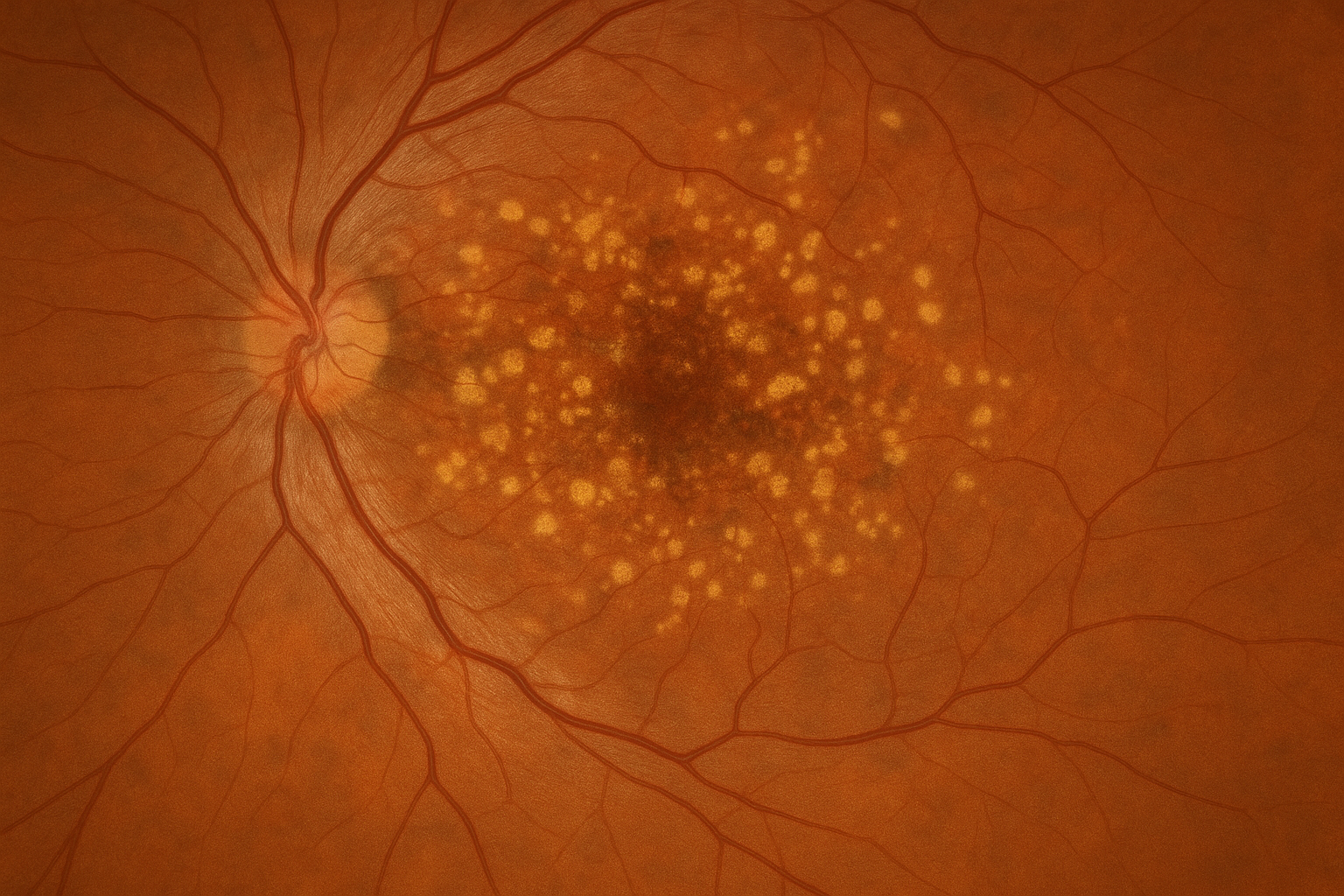
It happens when the cells in and around the macula gradually become damaged and break down. One of the characteristic signs is the development of drusen — small yellow deposits that build up underneath the retina.
Dry AMD usually develops gradually, and vision loss can range from mild to severe.
It can progress through different stages:
Early dry AMD: Often causes few or no noticeable symptoms. Small drusen may be present.
Intermediate dry AMD: Larger drusen and changes to the retina can cause some difficulty with detailed vision.
Late dry AMD (geographic atrophy): Areas of retinal cells can die, potentially causing significant central vision loss.
Importantly, dry AMD can sometimes progress to wet AMD, although not everyone with dry AMD will develop it.
🔴 Wet AMD
Wet AMD is less common but can cause much more rapid vision loss.
It occurs when abnormal blood vessels grow underneath or into the retina. These vessels are fragile and can leak fluid or blood, damaging the macula.
Because of this, wet AMD can cause symptoms to appear much more suddenly than with dry AMD.
Someone with wet AMD might notice:
Straight lines appearing wavy or distorted
A blurry or dark area in their central vision
Difficulty reading or recognising faces
A sudden deterioration in central vision
Wet AMD is particularly important to identify quickly because prompt treatment can help prevent further vision loss.
At Eyelines, our advanced equipment allows us to detect early signs of AMD and monitor any changes over time. We can also offer advice on ways to support your eye health, including supplements where appropriate.
If you notice any sudden changes to your vision, particularly distortion or a rapid loss of central vision, it's important to seek professional advice as soon as possible.